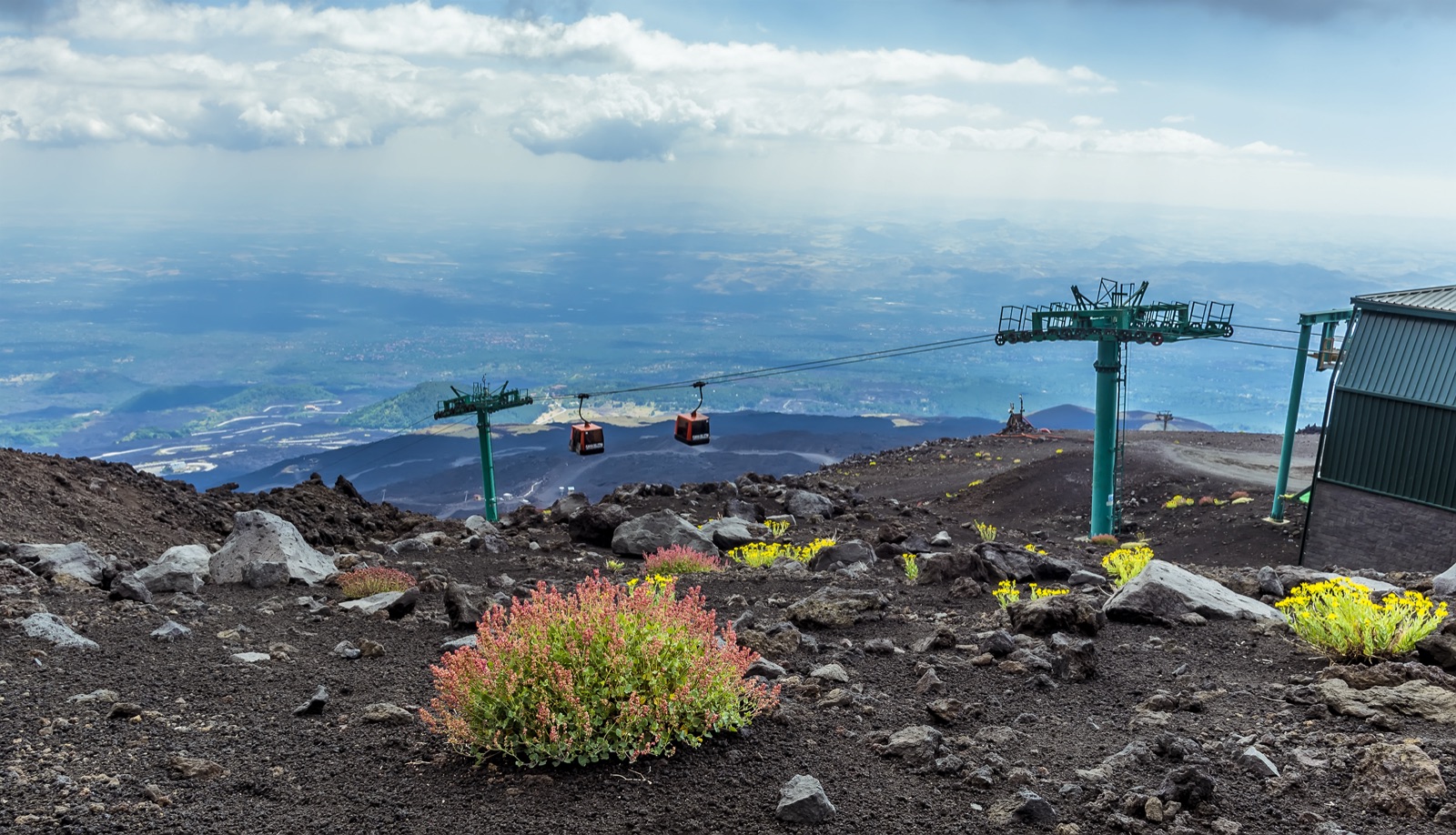
Etna Cable Car, 4x4 and Summit Craters: What You Can Do on Your Own
Most confusion about visiting Etna comes from one fact: the mountain is climbed in stages, each stage is sold separately, and the words people use — “the cable car”, “the summit”, “the craters” — mean different things to different operators. A ticket that says “Etna 3000” and a tour that says “summit craters” can end several hundred metres apart.
This guide goes up the south side one stage at a time, says what each stage costs and where it stops, and sets out the rules that decide where you can go on your own and where only a guided group can go.
The stages above Rifugio Sapienza
On the south side, everything starts from the Rifugio Sapienza area at 1,910 m, at the top of the SP92. From there the mountain is climbed in three stages:
| Stage | From | To | How |
|---|---|---|---|
| Cable car | 1,920 m | 2,500 m | Cabin lift from the station beside Rifugio Sapienza |
| Upper transfer | 2,500 m | 2,800 m | 4x4 bus in summer, snowcat in winter |
| Short guided walk | 2,800 m | 3,000 m | On foot with a volcanological guide |
Above that sits the summit zone, which is closed to independent visitors (more on that below).
Stage one: the cable car
The cable car climbs from its station at 1,920 m to 2,500 m. It is the stage almost everyone does, and on its own it is already worth it: at the upper station you are standing on bare volcanic ground well above the tree line, with the lower cones of the south flank spread out below you.
A return ticket for the cable car alone is €54. It is worth being clear about what that buys: it is transport, not a visit. The €54 ticket covers the cable car up and down, and nothing above the upper station.
Stage two: the 4x4 bus or the snowcat
From 2,500 m a 4x4 bus in summer — a snowcat in winter — continues to 2,800 m. The track crosses a landscape of ash, black sand and old lava, and it is here that most visitors first feel how big the volcano is: the summit area rises in front of you, and the coast is a long way below.
Stage three: the short guided walk to 3,000 m
From the end of the 4x4 track, a short trek with a volcanological guide goes on to 3,000 m. This is the highest point the standard packages reach, and it is where you get close views towards the summit craters without entering the summit zone itself.
What the package costs
The package that adds the upper stages — the 4x4 bus or snowcat and a guide — costs €82 in total, according to the prices the operator published and a check made on 8 September 2026. Put simply:
- €54 gets you to 2,500 m and back.
- €82 gets you to 2,800 m by 4x4 or snowcat and on to 3,000 m with a guide, and back.
Prices and operating days change, so treat these as a guide to the difference between the two options rather than a quote. The operator also offers windproof jackets, boots and poles for hire at altitude, which is useful if you arrive in city clothes.
The summit rules
This is the part many visitors do not expect: the highest part of Etna is not open to independent walkers.
Since August 2010, ordinances of the Prefecture of Catania have closed the summit zone of the volcano from 2,920 m at Torre del Filosofo on the south side and from 2,990 m at Punta Lucia on the north side. On top of that, visits to the summit craters must be accompanied by qualified alpine or volcanological guides, and access changes with the level of volcanic activity.
In practice this means three zones:
- Below the closure lines, you can walk the marked paths yourself. On the south side that includes the Silvestri craters near Rifugio Sapienza and the ground around the upper cable car station.
- Between the upper stations and the closure lines, the 4x4 bus and the short guided walk take you up to 3,000 m as part of a package.
- Above the closure lines, only guided groups go, and only when conditions allow.
The rules exist because Etna is not a dormant mountain with a scenic top. The summit craters are active, and the risks at those heights persist even when there is no visible eruption. The guides who lead groups there know the current state of the craters and the routes that are open on the day.
How high is Etna, anyway?
The answer changes with the eruptions. In 2021, after about 50 paroxysms at the South-East Crater, INGV — the national institute that monitors the volcano — reported a record height of 3,357 m. In July 2024 it measured the eastern rim of the Voragine crater at about 3,369 m, the greatest height ever measured on Etna.
So when a tour says it goes “to about 3,400 m”, it is describing the summit area, not a fixed peak. The number that matters for planning is not the summit height but the altitude at which the product you are booking actually stops.
Guided summit hikes: what the options look like
If the summit area is what you came for, you will book a guided hike. The main choices differ in how high they go and how they get you there.
The guided hike to the summit craters (about 3,400 m). The cable car does the first stage; then a volcanological guide leads the walk towards the summit craters across lava flows and volcanic sand. It takes about 5 hours, and pickup from Catania is optional. This is the one to choose if standing near the summit craters is the point of your trip and you are fit enough for a proper mountain walk.
Cable car, 4x4 and a walk to 3,000 m. The standard staged ascent as a guided product: cable car to about 2,500 m, a 4x4 to about 2,800 m, then a guided walk to around 3,000 m with the summit craters in view and a stop at a side crater. Also about 5 hours. This is the choice if you want to go high without committing to the full summit hike.
Upper craters day tour from Taormina. About 7 hours, with the transfer from Taormina included: a coach to the mountain, a 4x4 up to about 2,800 m and a walk with an alpine guide across ash slopes and volcanic rock towards the summit area.
The tours page lists all of them side by side with live prices.
What you can do without a guide
Plenty — just not the summit.
The Silvestri craters. A short walk from the Rifugio Sapienza car park, these old side craters are the easiest way to walk around real craters without any ticket. You can climb their rims, look into the hollows and see how the slopes around them are built from layers of cinder and lava.
The upper cable car station. With a cable-car-only ticket you can explore the ground around the upper station at 2,500 m. It is a different world from the refuge area below: almost no vegetation, dark ground and wide views.
The upper stages as a package. The 4x4 bus and the short walk to 3,000 m come with a guide included, so you are not on your own there, but you do not need to book a private guide or a separate tour.
What you cannot do is walk on from the top of the cable car to the summit craters by yourself. The closure line at 2,920 m on the south side is well below the summit area.
The north side
The north side works differently. The cable car described above is on the south side; Piano Provenzana, at about 1,800 m, is the base for guided excursions on the north side, and the summit zone there closes from 2,990 m at Punta Lucia. Guided excursions to the northern summit area start from here, and some tours that combine Etna with the Alcantara Gorges use the northern slope: the full-day tour to Etna and the Alcantara Gorges crosses the 2002 lava front by off-road vehicle and walks on the Sartorius craters before lunch and a swim in the gorges.
If you want the staged ascent with the cable car, go to the south side. If you want a quieter mountain and a guided walk, the north side is worth considering.
Closures and cancellations
Wind, cloud and volcanic activity can close the upper stages at short notice. The cable car and the 4x4 track are exposed, and the guided routes above them depend on the state of the craters on the day.
That has two practical consequences:
- Go up early if you can. If the upper stages close later in the day, you will already have been up.
- Read the cancellation terms of whatever you book. Each product sets its own terms for weather and volcanic closures. A tour that refunds or reschedules when the upper mountain is shut is worth more than one that does not.
Visiting the upper stages in winter
The staged ascent does not stop in winter, but it changes. The clearest sign is the upper transfer: the 4x4 bus of the summer months is replaced by a snowcat between 2,500 m and 2,800 m. That tells you what the upper slopes are like — snow-covered, with the track groomed rather than driven.
A few things follow from that:
- Dress for winter conditions, not for the coast. Full winter technical clothing is the advice from the guides for winter visits; a jacket that is fine for an evening in Catania is not enough at 2,800 m.
- Expect the upper stages to be more weather-dependent. Snow, wind and poor visibility all affect the upper track and the walks above it, so flexible plans and generous cancellation terms matter more in winter than in summer.
- The views can be better. A snow-covered Etna above a green coast is one of the classic views of Sicily, and on a clear winter day the contrast is striking.
Booking in advance or on the day
For the cable car alone, many visitors simply buy on arrival. The questions to ask yourself are how much time you have and how much you care about a particular slot.
Buy on the day if you are driving yourself, you are flexible about timing and you only want the cable car or the €82 package. You can look at the weather when you arrive and decide then.
Book in advance if you want a guided summit hike, you are travelling in a busy period, or you are coming on the bus with a fixed return time. Guided hikes run with small groups and limited places; the bus gives you a fixed window at the top, so arriving to find the next available slot is two hours away can wipe out the plan.
Book a tour if you want pickup, a guide for the whole day or the summit area. Tours that include the cable car handle the tickets for you; check whether the price includes the €54 transport or leaves you to buy it on the spot.
Who the summit hike is for
The guided hike towards the summit craters is a real mountain walk at altitude, on loose volcanic ground. It suits people who walk regularly and are comfortable on steep, uneven terrain. If that is not you, the staged ascent to 3,000 m gives you most of the scenery with a fraction of the effort, and the Silvestri craters give you a close look at volcanic landforms without any altitude at all.
Whichever you choose, the rule is the same: the guide decides on the day where the group goes, based on the state of the craters. That is not a formality — it is the reason the summit zone is guided-only in the first place.
Choosing between the options
A simple way to decide:
- You want to see Etna up close, with minimal effort. The cable car alone (€54 return) and a walk around the upper station, then the Silvestri craters on the way back.
- You want to go as high as you can without a serious hike. The €82 package: cable car, 4x4 or snowcat to 2,800 m and the guided walk to 3,000 m.
- You want the summit area. A guided summit hike, booked in advance, with cancellation terms you are comfortable with.
- You want someone else to handle the logistics. A tour with pickup from Catania or Taormina that includes the stage you want.
Frequently asked questions
How much is the Etna cable car?
A return ticket for the cable car alone is €54 (transport only, to 2,500 m). The package that adds the 4x4 bus or snowcat and a guide is €82. Those are the prices the operator published, as checked on 8 September 2026.
Can I walk to the summit craters from the cable car?
No. The summit zone is closed from 2,920 m on the south side and 2,990 m on the north side, and visits to the summit craters must be accompanied by qualified alpine or volcanological guides.
How high does the cable car go?
From 1,920 m to 2,500 m. The 4x4 bus (snowcat in winter) continues to 2,800 m, and the short guided walk goes on to 3,000 m.
What is the difference between “Etna 3000” and a summit crater hike?
The 3,000 m option is the staged ascent — cable car, 4x4, short guided walk — and stops below the summit zone. A summit crater hike is a longer guided walk into the summit area itself, towards 3,400 m.
Where is the cable car?
On the south side, beside Rifugio Sapienza at the top of the SP92. Piano Provenzana, at about 1,800 m on the north side, is the base for guided excursions there.
Can I hire boots and a jacket at the top?
Yes. Windproof jackets, boots and poles can be hired at altitude.